
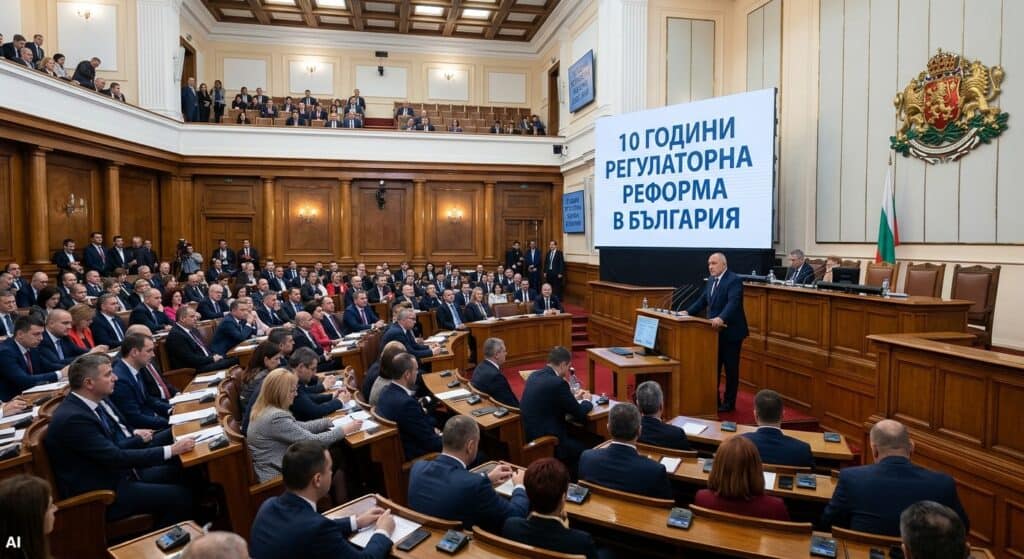
This is how the picture of regulatory reform in Bulgaria looks today, like a fake photo generated by artificial intelligence, in which almost nothing is real…
Exactly 10 years ago, in the news dedicated to the beginning of regulatory reform in Bulgaria, launched with the amendments and supplements to the Law on Regulatory Acts, I wrote that as of today (04.11.2016) Bulgaria joins the family of over 30 countries on the European continent, most of which are members of the European Union, which have adopted in one form or another the impact assessment as a mechanism that allows regulatory decision-making to be based on evidence. The Bulgarian legislative process is also becoming more democratic, because a new 1-month window for opinions, suggestions and recommendations of their users is opening for society through the mandatory public consultations.
How nice it would be if today the Bulgarian Parliament organized a solemn session dedicated to the achievements in the legislative process after 10 years of regulatory reform in Bulgaria. But this is neither the real plenary hall of the Bulgarian National Assembly, nor its chairman, nor the speaker at the moment, nor are the members of the Parliament real... The same applies to the regulatory reform.
Today, the several major achievements of the regulatory reform are something like fake news instead of reality:
- 1. The ex ante impact assessment carried out on the draft laws proposed by the National Assembly is completely ineffective, because it is not known whether it is complete or partial, it is applied formally and is devoid of meaning;
- 2. The ex-post impact assessment as provided for in the law is not applied by the National Assembly, i.e. in practice the feedback between the legislative process and the law enforcement activity is almost completely absent, because;
- 3. Public consultations on draft laws submitted by members of Parliament are not organised at all. Thus, the most representative body in the state, which is the National Assembly, refuses to monitor the pulse of society, the representatives of the people permanently do not listen to the voice of the people who elected them.
Attention!!! The current ratio of bills submitted to the National Assembly, according to the latest study of the legislative activity of the 51st National Assembly for the period November 11, 2024 1 January 3, 2026, conducted by the Parliamentary Research Department of the Library Information and Research Parliamentary Center is 75.6% - from members of the public against 24.4% from the Council of Ministers.
That is, where the reform is facade, formal and false, there the flow of draft legislation is most violent.
Within the Executive, where the Council of Ministers complies with the contemporary standards for better regulation, the reform actually works, but its positive effects extend to less than ¼ (24.4%) of all proposed draft legislation.
Whether the long-awaited regulatory reform in Bulgaria is a major (regulatory) failure in the pursuit of better life through better regulation, everyone should answer this question for themselves…
Happy anniversary!
